Radar and Laser Cross Section Engineering, Second Edition
Appendix B: Coordinate Systems

B.1 Orthogonal Coordinate Systems

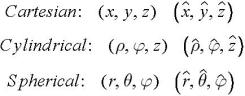
The three-dimensional coordinate systems used most often are


The quantities and unit vectors are illustrated in Fig. B.1. Some useful relationships that can be derived from the figure are


Fig. B.1: Orthogonal coordinate systems unit vectors.

These are orthogonal coordinate systems because the three basis vectors (unit vectors) are mutually orthogonal. For instance,


The Cartesian coordinate system is the only one in which the unit vectors are constant throughout space. In other words, , , always point in the same direction. This is not true for cylindrical and spherical coordinates; the unit vector directions change as a point is moved throughout space.

Consider two vectors in the spherical system. The first one is evaluated at a point P 1( r 1 , ? 1 , 1):


whereas the second one is evaluated at a point P 2( r 2 , ? 2 , 2):


If the sum of these two vectors is to be calculated at the same point in space ( P 2 = P 1), the spherical unit vectors are equal and the components of the two vectors simply add. However, computing the sum of vector at P 1 and at P 2 requires that and first be transformed to Cartesian coordinates.

B.2 Coordinate Transformations

The transformation of quantities from one coordinate system to another is frequently required. For example, consider a spherical charge that sets up an...

UNLIMITED FREE
ACCESS
TO THE WORLD'S BEST IDEAS

SUBMIT
Already a GlobalSpec user? Log in.

This is embarrasing...

An error occurred while processing the form. Please try again in a few minutes.

Customize Your GlobalSpec Experience

Category: Robots
Finish!
Privacy Policy

This is embarrasing...

An error occurred while processing the form. Please try again in a few minutes.