Radar and Laser Cross Section Engineering, Second Edition

4.7: Finite Integration Technique

4.7 Finite Integration Technique

The FIT is a time-domain numerical method based on the integral form of Maxwell s equations.15 Because it involves integrals rather than differentials, the FIT has some desirable properties compared to the FDTD. Integral quantities are more stable when doing extensive numerical calculations, as the case for a large grid or many time steps. The calculations deal with physically measurable quantities such as voltage and current, and energy and charge conservation are easily checked, which can be used to evaluate convergence.16

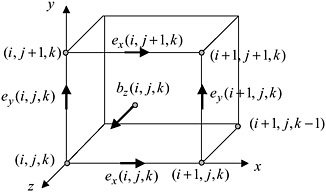
The detailed derivation of the discrete form of Maxwell s equations and their FIT application is described in Refs. 16 and 17. The purpose of this section is to highlight some of the important features of the FIT formulation and how it is implemented numerically. To begin, the target computational domain is discretized into subdomains, just as in the case of the FDTD method. Nonorthogonal and conformal grids are possible,17 but for illustrative purposes bricks are used as the cell geometry. A typical brick is shown in Fig. 4.40. The coordinates of node (x i , y j , z k ) are denoted by indices (i, j, k).


Fig. 4.40: Grid cell for implementing the FIT in three dimensions.

To illustrate the discretization process a couple of examples from Ref. 15 are repeated here. Maxwell s first equation (Faraday s law) is


For the front face let


where L denotes the path around the perimeter of the face s surface S. Similar definitions follow for...

UNLIMITED FREE
ACCESS
TO THE WORLD'S BEST IDEAS

SUBMIT
Already a GlobalSpec user? Log in.

This is embarrasing...

An error occurred while processing the form. Please try again in a few minutes.

Customize Your GlobalSpec Experience

Category: Finite-difference time-domain (FDTD) Software
Finish!
Privacy Policy

This is embarrasing...

An error occurred while processing the form. Please try again in a few minutes.