Radar and Laser Cross Section Engineering, Second Edition
In this appendix, several important aspects of antenna theory and analysis are presented. Because radar cross section and antenna radiation are closely related, many of the same analysis techniques apply. In a sense, a radar target can be viewed as an antenna structure that is excited by a distant voltage source. Antenna parameters applicable to RCS analysis are directivity (or gain), half-power beamwidth, effective aperture and effective height, and sidelobe level. Antenna performance is generally defined in the far field or far zone. If the antenna is at the origin, the standard (although arbitrary) far-field condition is r > (2 L 2 / ?), where L is the maximum antenna dimension.
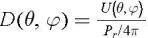
Directive gain D is a measure of how well an antenna concentrates the energy it radiates. Mathematically,
U ( ?,
) is the radiation intensity in the direction ( ?,
) in units of watts per steradian (W/sr), and P r is the total radiated power. The factor 4 ? in the denominator implies that the reference level for directive gain is an isotropic source, that is, one that radiates uniformly in all directions. Directive gain is usually expressed in units of decibels relative to an isotropic source (dBi):
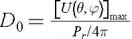
The maximum value of the directive gain over all angles is the directivity:
The terms directivity and directive gain imply a lossless antenna. When losses are included, the term gain is used.