Fiber Optic Reference Guide: A Practical Guide to Communications Technology, Third Edition
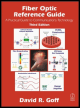
This guide is an ideal primer for newcomers to the fiber optics industry as well as a useful reference guide for seasoned fiber optics veterans.
 TABLE OF CONTENTS
 Semiconductor optical amplifiers (SOA's) are essentially laser diodes, without end mirrors, which have fiber attached to both ends. They amplify any optical signal that comes from either fiber and transmit an amplified version of the signal out the second fiber. An SOA can be constructed in a small package, and they work for 1310 nm or 1550 nm systems. In addition, SOA's transmit bidirectionally, making the reduced size of the device an advantage over regenerators or EDFA's. Drawbacks to SOA's include high-coupling losses, polarization dependence, and a higher noise figure. Figure 7.1 illustrates the basics of a semiconductor optical amplifier.
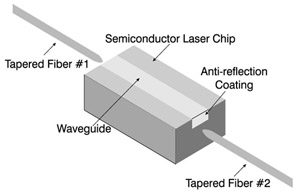
Modern optical networks utilize SOA's in a number of ways including:
Power Booster: Many tunable laser designs output low optical power levels and must be immediately followed by an optical amplifier, usually either an SOA or EDFA.
In-Line Amplifier: Allows signals to be amplified within the signal path.
Wavelength Conversion: Covered later in this chapter, this involves changing the wavelength of an optical signal.
Receiver Preamplifier: SOA's can be placed in front of detectors to enhance sensitivity.
The breakthrough development of erbium-doped fiber amplifiers (EDFA's) allows longhaul DWDM systems to flourish. Before EDFA's, DWDM systems required electronic repeaters at intermediate points about 100 km apart. Repeater's are essentially a fiber optic receiver connected directly to a fiber optic transmitter. EDFA's allow the transmission of optical signals over longer distances without the need for repeaters. EDFA's...