Fiber Optic Reference Guide: A Practical Guide to Communications Technology, Third Edition
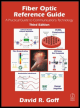
This guide is an ideal primer for newcomers to the fiber optics industry as well as a useful reference guide for seasoned fiber optics veterans.
 TABLE OF CONTENTS
 Video signals are complicated. A close inspection of a television screen reveals that the picture is comprised of many horizontal lines drawn one after another. The video signal contains the information to draw these lines, detailing whether parts of the line should be dark or light and how to display the colors. Sound is also encoded in the signal.
There are three predominant methods of encoding a video signal: amplitude modulation (AM), frequency modulation (FM) and digital modulation. (See Table 12.1.)
| Parameter | AM | FM | Digital |
|---|---|---|---|
| Signal-to-Noise Ratio | Low-Moderate | Moderate-High | High |
| Performance vs. Attenuation | Sensitive | Tolerant | Invariant |
| Transmitter Cost | Moderate-High | Moderate | High |
| Receiver Cost | Moderate | Moderate-High | High |
| Receiver Gain Adjustment | Often Req. | Not Req. | Not Req. |
| Installation | Adjustments Req. | No Adjustments Req. | No Adjustments Req. |
| Multichannel Capability | Good Capability Req. | Fewer Channels | Good |
| Performance Over Time | Moderate | Excellent | Excellent |
| Environmental Factors | Moderate | Excellent | Excellent |
The difference between various modulation schemes can be understood by examining their corresponding frequency spectra. The very simple baseband AM occupies the region from DC to about 5 MHz and requires the least bandwidth (assuming we are talking about uncompressed digital encoding techniques). The RF carrier modulation spectrum is similar; it has been shifted to a non-zero frequency (F). This approach requires additional bandwidth and offers no advantage over baseband operation in a system where a single channel is carried on each fiber. However, it allows multiple channels to...