Fiber Optic Reference Guide: A Practical Guide to Communications Technology, Third Edition
This guide is an ideal primer for newcomers to the fiber optics industry as well as a useful reference guide for seasoned fiber optics veterans.
 TABLE OF CONTENTS
 After the fiber, connectors and splices rank as the most important passive devices in a fiber optic system. Other types of passive devices include couplers, splitters, tap ports, switches, and wavelength-division multiplexers. These devices divide, route, or combine multiple optical signals.
Fiber optic couplers either split optical signals into multiple paths or combine multiple signals on one path. Optical signals differ from electrical signals, making optical couplers trickier to design than their electrical counterparts. Like electrical currents, a flow of signal carriers, in this case photons, comprise the optical signal. However, an optical signal does not flow through the receiver to the ground. Rather, at the receiver, a detector absorbs the signal flow. Multiple receivers, connected in a series, would receive no signal past the first receiver which would absorb the entire signal. Thus, multiple parallel optical output ports must divide the signal between the ports, reducing its magnitude.
The number of input and output ports, expressed as an N M configuration, characterizes a coupler. The letter N represents the number of input fibers, and M represents the number of output fibers. Fused couplers can be made in any configuration, but they commonly use even multiples of two (2 2, 4 4, 8 8, etc.).
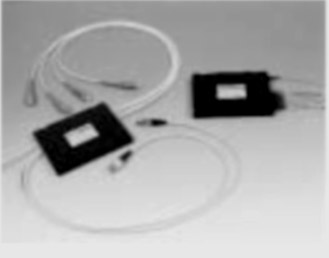
The simplest couplers are fiber optic splitters. These devices possess at least three ports but may have more than 32 for more complex devices. A simple 3-port...