Fiber Optic Reference Guide: A Practical Guide to Communications Technology, Third Edition
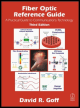
This guide is an ideal primer for newcomers to the fiber optics industry as well as a useful reference guide for seasoned fiber optics veterans.
 TABLE OF CONTENTS
 After discussing the intricacies of video transmission over fiber, we will now look at data transmission where fiber excels because of high bandwidth, low loss, and EMI/RFI/lightning immunity. These characteristics are more important in some applications than in others. In security applications, EMI/RFI/lightning immunity is the paramount consideration. For very long distance applications, low loss prompts the choice for fiber. For highspeed applications, such as gigabit data rates between computers, the high bandwidth determines the use of fiber. After the initially deciding to use fiber optics for a data transmission requirement, other decisions must follow such as:
Operating wavelength
Optical loss budget
Fiber type
Fiber size
Optical connector type
Whereas analog transmission over fiber often uses a carrier transmission, digital data transmission typically uses baseband transmission. This means that a logic 0 is sent as a low light level (or the light may be completely off) and a logic 1 is sent as a high light level. Often, employing some sort of data coding (e.g., 4B5B, 8B10B, etc.) guarantees minimum transition density. This coding scheme alleviates the difficulty in designing a fiber optic data link that includes true DC or steady-state data rates requires this data coding. Low data rates (typically <1 MHz) accommodate true DC, but achieving this becomes increasingly difficult at higher data rates, mainly because of the relatively poor DC performance of amplifiers capable of high frequencies.
True DC response is difficult because negative light does not exist. Light is an unbalanced...