Fiber Optic Reference Guide: A Practical Guide to Communications Technology, Third Edition
This guide is an ideal primer for newcomers to the fiber optics industry as well as a useful reference guide for seasoned fiber optics veterans.
 TABLE OF CONTENTS
 Now that we have completed the discussion of today's fiber optic system elements, the focus will shift to the fiber optic systems of tomorrow. The future of fiber optic advances lies in increased capacity for every aspect of the fiber optic system. However, the need to increase fiber capacity leads to the primary field of research for fiber optics.
Many of the developments discussed in this chapter originally evolved from other technologies such as wireless technology. The use of ever more exotic coding schemes and techniques, such as forward error correction (FEC), indicate that current fiber technology has yielded all of the "easy" bandwidth. These advanced techniques potentially increase the capacity of a single fiber from roughly 1 terabit capacity today to perhaps 10 terabits per second in the next five years. How high can fiber go? Years ago experts said of dial up computer modems that 28.8 kBaud was the absolute data rate limit. A few months later, designers announced the development of 56 kBaud modems. Fiber's absolute limit may or may not exceed 10 terabits per second; that goal seems achievable, but it will be extraordinarily complex and expensive. Figure 14.1 illustrates the potential capacity for the growth of fiber optic transmission rates.
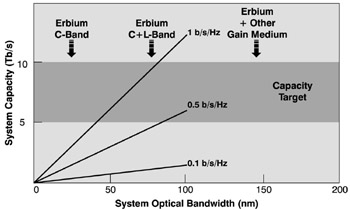
Some estimates of fiber's ultimate capacity range from 25 Tb/s to as high as 100 Tb/s. As the bandwidth per fiber goes higher, the next concern regards the supportable distance. If the maximum distance reaches only a few kilometers,...