Gas Well Testing Handbook
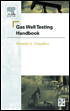
Offering a thorough understanding of gas well test analysis basics, this book focuses on practical field application, where over 100 field examples are presented to illustrate basic methods for analysis.
 TABLE OF CONTENTS
 Gas well test analysis is a branch of reservoir engineering. Information derived from flow and pressure transient tests about in-situ reservoir conditions is important in many phases of petroleum engineering. The reservoir engineer must have sufficient information about the reservoir/well condition and characteristics to adequately analyze reservoir performance and forecast future production under various modes of operation. The production engineer must know the condition of production and injection wells to persuade the best possible performance from the reservoir.
Pressures are most valuable and useful data in reservoir engineering. Directly or indirectly, they enter into all phases of reservoir engineering calculations. Therefore accurate determination of reservoir parameters is very important. In general, gas well test analysis is conducted to meet the following objectives:
To obtain reservoir parameters.
To determine whether all the drilled length of gas well is also a producing zone.
To estimate skin factor or drilling and completion related damage to a gas well. Based upon magnitude of the damage a decision regarding well stimulation can be made.
The first analysis was based on the empirical method applicable to very porous and permeable reservoirs developed by Schellherdt and Rawlins,1 Back-Pressure Data on Natural Gas Wells and Their Application to Production Practices. Monograph 7, U.S.B.M. This method today is known as the four-point (sometimes as the one-point) method. The [(  ) versus q sc] square of the average...