Gas Well Testing Handbook
Offering a thorough understanding of gas well test analysis basics, this book focuses on practical field application, where over 100 field examples are presented to illustrate basic methods for analysis.
 TABLE OF CONTENTS
 This chapter discusses various types and testing of gas layered reservoir systems including multilayered responses in fractured reservoirs. It also describes crossflow identification and the nature and degree of communication between layers. Performance equations for cases of constant flowing pressure and constant producing rate are presented and discussed. The chapter also reviews layer effect on pressure and/or production behavior including economic aspects of interlayer crossflow.
Layered reservoirs can be classified into four groups.
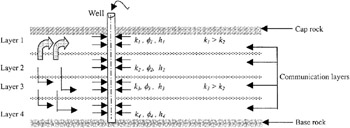
Figure 13 1 shows a crossflow reservoir, which consists of four continuous layers that are communicating at the contact planes. These layers are not entirely separated by impervious layers, therefore interlayer crossflow could occur during the test. The crossflow would be directed from the layer of low permeability to the layer of higher permeability, as shown in the figure. If k 1 is greater than k 2, then the pressure transients would travel faster in the layer of permeability k 1 than in the layer of permeability k 2. The duration of the crossflow periods depends on the storage of each layer. If the storage of the layer of permeability k 1 is negligible when compared to the storage of the layer of permeability k 2, then the crossflow will continue throughout the life of the well. If the opposite occurs, then the duration of the crossflow period will be short.
This type of...