Gas Well Testing Handbook

Offering a thorough understanding of gas well test analysis basics, this book focuses on practical field application, where over 100 field examples are presented to illustrate basic methods for analysis.
 TABLE OF CONTENTS
 This chapter deals with analysis of decline curves during the transient and pseudo-steady-state flow periods. Classifications of production decline curves and their practical uses are discussed with field examples including methods to forecast performance of horizontal and vertical fracture gas reservoirs.
The solution in Figure 16 1 presents the behavior of a well during the transient period, when it behaves as an infinite reservoir. Accordingly, this decline solution is referred to as infinite acting. The terms infinite-acting decline and transient decline are used interchangeably. Note: The rapid rate decline is normal transient behavior. Figure 16 1 is useful for test analysis by type curve matching.
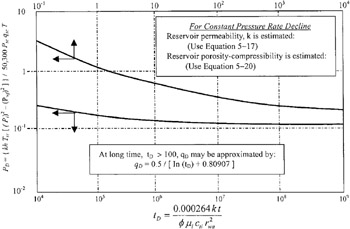
It is related to the dimensionless rate by

where

and solving for the skin factor;

If rules during transient flow are used to compute the value of exponent b, then such measurements may suggest that the value of b is greater than unity and is given by
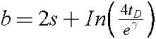
In most cases the exponent b would be greater than unity, if transient responses were used to predict performance. Behavior in rate will follow the b=0 curve only for the case ? t/ c t =constant as long as c t / ? t is a linear function of time.
This section illustrates the use of the general infinite-acting solution...