Gas Well Testing Handbook

Offering a thorough understanding of gas well test analysis basics, this book focuses on practical field application, where over 100 field examples are presented to illustrate basic methods for analysis.
 TABLE OF CONTENTS
 This chapter discusses basic flow equations expressed in terms of the pseudopressure ?( p) and of approximations to the pseudopressure approach that are valid at high and low pressures. This is followed by deliverability tests of gas well flow-after-flow, isochronal, and modified isochronal deliverability tests including a simplified procedure for gas deliverability calculations using dimensionless IPR curves. The purpose of this chapter is to provide a complete reference work for various deliverability testing techniques. The mathematical determinations of the equations are avoided; this role is filled much better by other publications.1 2 Field examples are included to provide a hands-on understanding of various deliverability testing techniques, their interpretations and their field applications.
References 1 and 3 have shown that gas flow in an infinite-acting reservoir can be expressed by an equation similar to that for flow of slightly compressible liquids if pseudopressure ?( p) is used instead of pressure. The equation in SI units is

In field units this equation becomes
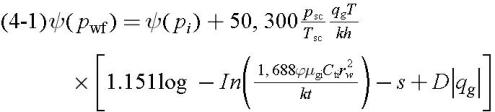
where the pseudopressure is defined by the integral
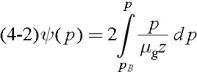
where p B is some arbitrary low base pressure. To evaluate ?( p wf) at some value of p, we can evaluate the integral in Eq. 4 2 numerically, using values for and z for the specific gas under consideration, evaluated at reservoir temperature. The term D q g gives a non-Darcy flow pressure drop, i.e., it takes into account...