Gas Well Testing Handbook

Offering a thorough understanding of gas well test analysis basics, this book focuses on practical field application, where over 100 field examples are presented to illustrate basic methods for analysis.
 TABLE OF CONTENTS
 This chapter discusses two well-testing techniques not yet discussed in the text: interference tests and pulse tests. This chapter also discusses various cross plotting techniques, the appearance of common flow regimes, log-log diagnostic, Horner, and specialized plots, and their field applications. Details and supporting materials are also presented in this chapter for the benefit of those who would like to learn more.
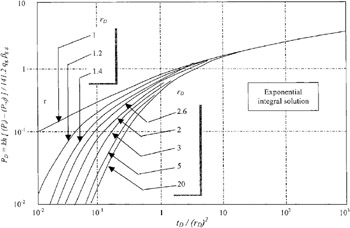
Interference tests are used to determine whether two or three wells are in pressure communication (i.e., in the same reservoir) and, when communication exists, to provide estimates of permeability k and porosity/compressibility product  c t in the vicinity of the tested well. Convenient analysis techniques for interference tests are the use of type curves. Figure 12 1 shows these type curves, presented by Earlougher,4 which are plot of the logarithm of p D( r D, t D) versus the logarithm of t D/
  . Using the following equations generate these type curves:

or

where


Evaluation of Eq. 12 1 gives the type curves shown in Figure 12 1. Figure 12 1 shows p D as a function of t d and r D, the dimensionless radius distance from the well, for the infinite-acting system. When r D ? 20 and t D/ ? 0 .5, or when t D/ ? 25, r d