Gas Well Testing Handbook

Offering a thorough understanding of gas well test analysis basics, this book focuses on practical field application, where over 100 field examples are presented to illustrate basic methods for analysis.
 TABLE OF CONTENTS
 Deliverability testing is a commonly used technique for predicting shortterm and long-term behavior of gas wells. Typically, a well is flowed at different rates, and the pressure rate time response is recorded. From analysis of these data, information is obtained regarding the deliverability of the well, i.e., its ability to produce against a given backpressure at a given stage of reservoir depletion. Such forecasting is often required input for designing production facilities, planning field development, estimating payout time, setting allowable rates, etc. Deliverability testing has been done using multipoint flow tests. Empirical equations5 ,7 to predict current and future gas well deliverability are presented. Deliverability calculations for both unfractured and fractured gas wells are also briefly discussed in this chapter.
The basic assumptions are:
Homogeneous, isotropic, unfractured reservoir with a closed outer boundary
Single, fully penetrating well
Stabilized conditions prevail, i.e., pseudo-steady-state equations can be used to describe gas flow in the reservoir
Turbulent factor D and a rate-dependent skin Dq sc.
Under these assumptions, the drawdown equation, in gas-field units, is
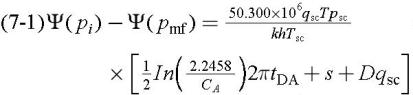
After rearranging, Eq. 7 1 becomes
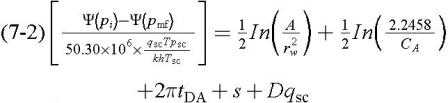
For a closed drainage volume, material balance gives
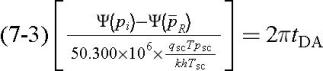
Combining Eqs. 7 2 and 7 3, we have

This equation can now be rewritten as the familiar quadratic deliverability equation:

where the coefficients a and b are given by


Solving Eq. 7 5 and taking the positive root to be q sc,

and corresponding to a zero sandface pressure, the absolute open flow potential...