Gas Well Testing Handbook

Offering a thorough understanding of gas well test analysis basics, this book focuses on practical field application, where over 100 field examples are presented to illustrate basic methods for analysis.
 TABLE OF CONTENTS
 This chapter discusses the quantitative use and applications of type curves in gas well test analysis. The most generally useful type curves have been selected and are included herein. Fundamentals of type-curve use are presented and will allow the reader to understand and to apply newer type curves as they appear in the literature.
Transient behavior of a gas well with a finite conductivity vertical fracture has been simulated by Cinco and Samaniego.9 Usually it is assumed that fractures have an infinite conductivity.
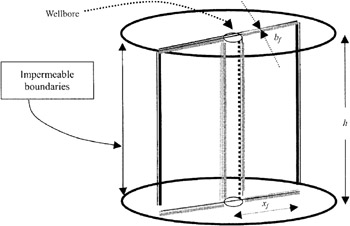
Finite-conductivity vertical fracture in an infinite slab is shown in Figure 11 1. Pressure data for each flow period should be analyzed using specific interpretation methods8 ,9 such as
? ? versus (t) 1 / 4 for bilinear flow
? ? versus (t) 1 / 2 for linear flow
and
? ? versus log t for pseudoradial flow
There are four important flow regimes, which are discussed in the following sections.
During this flow period, most of the fluid entering the wellbore comes from the expansion of the system within the fracture and the flow is essentially linear, as shown in Figure 11 2. Pressure response at the wellbore is given by

Hence

Equation 11 2 indicates that a log-log graph of pressure difference against time yields a straight line whose slope...