Gas Well Testing Handbook

Offering a thorough understanding of gas well test analysis basics, this book focuses on practical field application, where over 100 field examples are presented to illustrate basic methods for analysis.
 TABLE OF CONTENTS
 References 1 and 2 presented a new set of type curves. These type curves were specifically needed for massive hydraulic fractured (MHF) wells to handle production under constant pressure and constant rate. A fracture is said to have an infinite flow capacity when there is little or no pressure drop along the axis of the fracture. The fracture is said to have a finite flow capacity when there is a significant pressure drop along its axis. Since the distinction between the definitions of fracture flow capacity and formation flow capacity is often confusing, it may be worthwhile to restate the definition of the formation flow capacity:


Figure 10 1 illustrates method of analyzing massive hydraulic fractured gas wells.
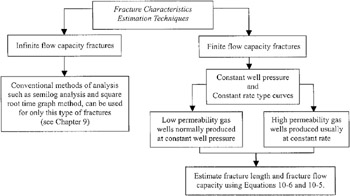
Figure 10 2 presents constant wellbore pressure type curves for finite flow-capacity fractures. These type curves are especially useful when analyzing performance data (production rate versus time) for MHF gas wells that generally are produced at a constant wellbore pressure, rather than a constant rate. The reciprocal of the dimensionless rate, 1 /q D, was plotted as a function of dimensionless time, t Dxf, on log-log paper with dimensionless fracture flow capacity, F CD, as a parameter. Definitions of 1 /q D , t Dxf, and F CD are as follows:
Dimensionless rate, 1