Introduction to Aeronautics: A Design Perspective, Second Edition

"It is our duty not to rest until we have attained to a perfect scientific conception of the problem of flight."
Otto Lilienthal
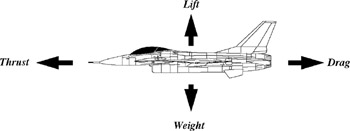
Figure 2.1 depicts the forces acting on an aircraft in flight. The motion of the aircraft is determined by its mass and velocity and by the directions and magnitudes of these forces. Three of the four forces, lift, drag, and thrust, result from the interactions of the aircraft and its propulsion system with the air around it. Lift and drag are called aerodynamic forces because they result from the motion of the aircraft through the air. The aircraft designer shapes and optimizes the aircraft to control the production of these forces, maximizing the lift and thrust extracted from the air while minimizing the penalties paid in drag and fuel consumption. The characteristics of the air through which the aircraft is flying heavily influence the magnitudes of these forces. For this reason, the aircraft designer must understand the characteristics and interrelationships of the properties of air.
The performance requirements listed in Table 1.2 specify altitudes and Mach numbers that must be achieved. To facilitate documentation of a particular aircraft's performance and to ensure fair comparisons between competing designs, a standard model for the Earth's atmosphere has been defined. This widely accepted model is called the standard atmosphere. By reference to it, any two engineers evaluating aircraft performance at...