Introduction to Aeronautics: A Design Perspective, Second Edition

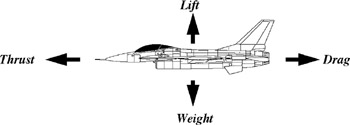
Consider again the case of steady, level, unaccelerated flight with the thrust vector aligned with the velocity. Figure 5.12 illustrates this situation. If the aircraft is in steady flight, not accelerating, forces must be in balance. Therefore, lift must equal weight, and thrust must equal drag. The lift requirement can be used to determine the required lift coefficient at any freestream velocity or Mach number:
Once C L is known, the aircraft's drag polar can be used to determine C D and then D at that velocity:
If the calculation of drag is performed for a range of velocities, and for a fixed aircraft weight and altitude, a drag curve is generated. The drag is also called thrust required T R because it is the thrust required from the engine to sustain steady, level flight for the given conditions. Figure 5.13 shows a drag curve for a typical subsonic aircraft. The drag is shown as the sum of parasite drag and induced drag. Note that parasite and induced drag are equal, each making up half the total drag, at the point on the curve where drag is a minimum. A thrust available model for an appropriately sized nonafterburning low-bypass-ratio turbofan engine [Eq. (5.11)] is also shown on Fig. 5.13. The thrust and drag curves are not drawn for velocities much faster than the speed where thrust available equals thrust required because the aircraft does not have enough...