Introduction to Aeronautics: A Design Perspective, Second Edition

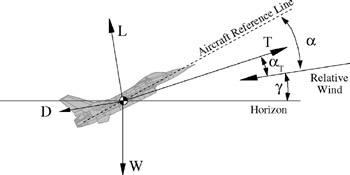
Figure 5.1 shows the forces and geometry for an aircraft in a climb. The flight-path angle ? is the angle between the horizon and the aircraft's velocity vector (opposite the relative wind). The angle of attack ? is defined between the velocity vector and an aircraft reference line, which is often chosen as the central axis of the fuselage rather than the wing chord line. The choice of the aircraft reference line is arbitrary. The designer is free to choose whatever reference is most convenient, provided care is taken to clearly specify this choice to all users of the aircraft performance data. The thrust angle ? T is the angle between the thrust vector and the velocity vector. This will not, in general, be the same as ?, because the thrust vector will not generally be aligned with the aircraft reference line.
The equations of motion for the aircraft in Fig. 5.1 are derived by summing the forces on the aircraft in two directions, one parallel to the aircraft's velocity vector and one perpendicular to it. These directions are convenient because lift was defined in Chapter 3 as the component of the aerodynamic force that is perpendicular to the velocity vector, and drag was defined as the component parallel to velocity. The summation parallel to the velocity is
where m is the aircraft's mass and a is its instantaneous acceleration in...