Introduction to Aeronautics: A Design Perspective, Second Edition

5.7: Curve Shifts

5.7 Curve Shifts

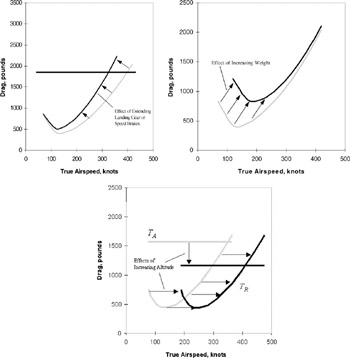
Changes in aircraft weight and configuration change the power required and thrust required curves. Figure 5.17 illustrates these changes for thrust required.


Figure 5.17: Changes to thrust and drag curves with configuration, weight, and altitude changes.

Generally, changing aircraft configuration involves extending landing gear, speed brakes, or high-lift devices, all of which increase C D 0 without changing k significantly. High-lift devices usually have the largest effect on C D 0, but they also increase C L max, so their effect on the curve is more complex. Figure 5.17 shows the effect of deploying speed brakes, spoilers, or landing gear, which only increase C D 0. Note that parasite drag is increased at all speeds, but induced drag is unchanged. Because parasite drag is largest at high speeds, the net effect is to shift the drag curve up and to the left. Increasing weight changes the induced drag without changing parasite drag. Because induced drag is greatest at low speeds, the net effect is to shift the curve up and to the right.

Figure 5.17 also illustrates the effect of changes in altitude on the thrust and drag vs velocity curves. Because the true airspeed for a given dynamic pressure increases as density decreases, the effect of increasing altitude is to shift the curves to the right, without changing their shape. This is true as long as true airspeeds do not increase above the aircraft's critical Mach number. Above M crit,...

UNLIMITED FREE
ACCESS
TO THE WORLD'S BEST IDEAS

SUBMIT
Already a GlobalSpec user? Log in.

This is embarrasing...

An error occurred while processing the form. Please try again in a few minutes.

Customize Your GlobalSpec Experience

Category: Wind Tunnel Testing Services
Finish!
Privacy Policy

This is embarrasing...

An error occurred while processing the form. Please try again in a few minutes.