Introduction to Aeronautics: A Design Perspective, Second Edition

For propeller-driven aircraft, engine performance is specified in terms of power. A chart that is analogous to Fig. 5.13 is easily developed, but with drag expressed as power required P R using the relationship
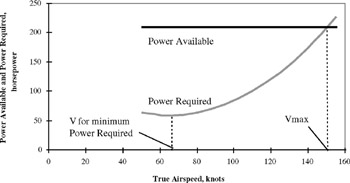
Figure 5.15 illustrates a power-required curve for a typical propeller-driven aircraft. The power-available model for an appropriately sized reciprocating engine/propeller combination, obtained by multiplying Eq. (5.9) by V ?, is also plotted on the figure. The airspeed where power available equals power required is the aircraft's V max for that altitude and aircraft weight. For a propeller-driven aircraft, the airspeed where power required is a minimum is, among other things, the speed at which the aircraft can maintain level flight at that altitude and weight with the minimum engine throttle setting.
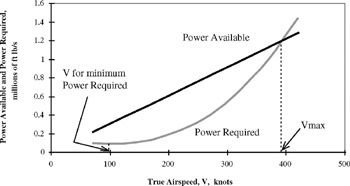
Power curves are also useful in predicting the performance of turbojet-and turbofan-driven aircraft. Figure 5.16 illustrates power-available and power-required curves for the same aircraft whose thrust-available and thrust-required curves are shown in Figure 5.13. The curves are obtained by multiplying thrust and drag at each point by the freestream velocity. Note that minimum power required occurs at a lower velocity than minimum thrust required. For this flight condition, induced drag is three times as great as parasite drag, that is, 3 C D 0 = kC 2 L.
What is...