Introduction to Aeronautics: A Design Perspective, Second Edition

5.8: Glides

5.8 Glides

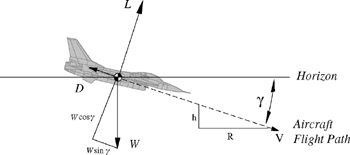
Figure 5.18 shows an aircraft in a power-off glide. The aircraft's flight-path angle ? is taken as positive downward, and the thrust is zero. With these changes Eqs. (5.1) and (5.2) simplify to


5.8.1 Maximum Glide Range

To determine the aircraft speed that will produce the maximum glide range, first note in Fig. 5.18 that the aircraft's distance traveled through the air has two components, the vertical altitude lost in the glide h and the horizontal distance or range traveled R. For a fixed initial altitude, the range is maximized when the magnitude of the flight-path angle is as small as possible. The limit to how small ? can get, while still sustaining steady flight, is set by the force balance in Eq. (5.25). Combining Eqs. (5.25) and (5.26),


Figure 5.18: Aircraft in a power-off glide.

The message in Eq. (5.27) is that the aircraft will achieve its flattest glide angle and its longest glide range when the aircraft is flown at the speed for ( L/ D) max. Another useful result is


It is significant that weight is not a variable in Eq. (5.28). Because L/ D is a function of C L and ( L/ D) max is achieved for a specific value of C L [Eq. (5.21)], the velocity for maximum glide range increases with weight, but the glide ratio R/ h does not change.

Example 5.4

An aircraft...

UNLIMITED FREE
ACCESS
TO THE WORLD'S BEST IDEAS

SUBMIT
Already a GlobalSpec user? Log in.

This is embarrasing...

An error occurred while processing the form. Please try again in a few minutes.

Customize Your GlobalSpec Experience

Category: Flight Displays
Finish!
Privacy Policy

This is embarrasing...

An error occurred while processing the form. Please try again in a few minutes.