Introduction to Aeronautics: A Design Perspective, Second Edition

5.9: Climbs

5.9 Climbs

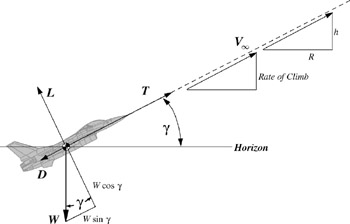
Figure 5.1 depicts an aircraft in a climb. Assuming thrust is approximately aligned with the flight-path vector and that the maneuver is a steady climb, the situation simplifies to that shown in Fig. 5.20. Equations (5.1) and (5.2) simplify to


Figure 5.20: Aircraft in a climb.


5.9.1 Maximum Climb Angle

The requirement to climb at maximum angle (maximum height gained for minimum ground distance traveled) is normally the result of some obstacle (e.g., trees, buildings, mountains, etc., or an altitude restriction imposed by a regulatory agency) in the flight path, which must be cleared. Equation (5.30) suggests that the maximum sustainable climb angle will be achieved for conditions that produce the maximum T ? D and minimum aircraft weight. For nonafterburning turbojets and low-bypass-ratio turbofans [thrust model Eq. (5.10)], maximum T ? D will occur at the velocity for D min and ( L/ D) max because thrust is constant with velocity. Maximum T ? D for aircraft with other types of propulsion systems can be found graphically by comparing thrust and drag curves.

5.9.2 Maximum Rate of Climb

The requirement to climb at maximum rate normally stems from a need to quickly, and with minimum fuel expenditure, get to higher altitudes where the aircraft's maximum range and best cruise airspeeds are higher (and on a hot day in Texas, where the air is cooler). As shown on Fig. 5.20, the rate of climb is the vertical component of the aircraft's...

UNLIMITED FREE
ACCESS
TO THE WORLD'S BEST IDEAS

SUBMIT
Already a GlobalSpec user? Log in.

This is embarrasing...

An error occurred while processing the form. Please try again in a few minutes.

Customize Your GlobalSpec Experience

Category: Flight Displays
Finish!
Privacy Policy

This is embarrasing...

An error occurred while processing the form. Please try again in a few minutes.