Introduction to Aeronautics: A Design Perspective, Second Edition

Production of thrust is a topic that could easily occupy an entire chapter or even an entire book. Its treatment here will be limited to the general concepts needed to predict aircraft performance.
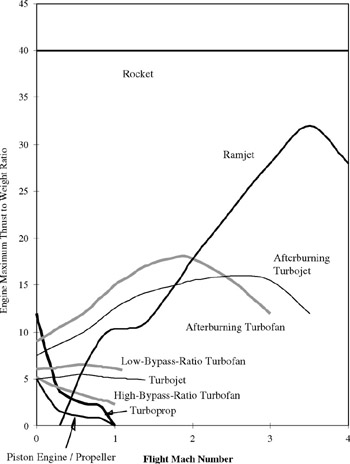
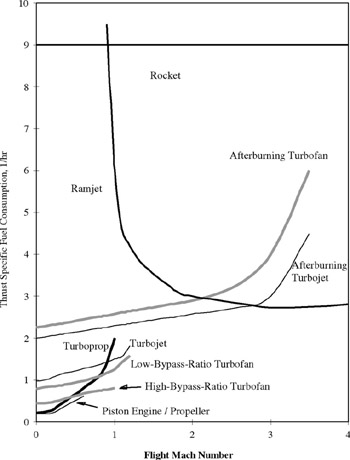
The aircraft designer has a wide range of choices for propulsion systems. Each system has characteristics that make it most suitable for particular flight regimes. One of the characteristics of most interest is the ratio of an engine's sea-level output to its own weight T SL/ W eng. Another is the engine's thrust-specific fuel consumption (TSFC), which is the ratio of rate of fuel consumption to thrust output:
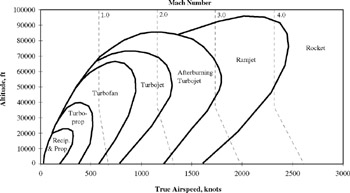
TSFC is frequently represented by the symbol c t. If fuel consumption rate has units of pounds per hour and thrust is in pounds, then TSFC has units of reciprocal hours. An engine that is deemed suitable for a particular flight regime would have a relatively high T SL/ W eng and a relatively low TSFC in that regime. Figures 5.2 and 5.3 show the variation of T SL/ W eng and TSFC with Mach number for several types of engines. Figure 5.4 shows common operating envelopes (ranges of operating altitudes and Mach numbers) of common engine types. Each engine type is described in more detail in the following paragraphs.