Introduction to Aeronautics: A Design Perspective, Second Edition

"Isn't it astonishing that all these secrets have been preserved for so many years just so that we could discover them!!"
Orville Wright
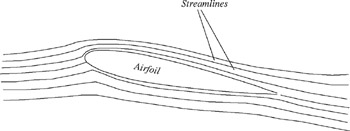
Figure 3.1 shows a cross-section view of an aircraft wing. A wing cross section like this is called an airfoil. Lines called streamlines drawn above and below the airfoil indicate how the air flows around it. The shape of the airfoil and the pattern of airflow around it have profound effects on the lift and drag generated by the wing. Aircraft designers choose a particular airfoil shape for a wing in order to optimize its lift and drag characteristics to suite the requirements for a particular mission. It is essential that an aircraft designer understand how the changes that occur in air as it flows past a wing create lift and drag and how airfoil shape influences this process.
The changes that occur in the properties of moving air as it encounters obstructions provide the basis for the airspeed indicating systems used on most aircraft. An understanding of how these systems work is essential to anyone who designs, builds, or operates aircraft.
A number of terms must be defined to facilitate a discussion of aerodynamics. The lines in Fig. 3.1 that indicate how the air flows are known as streamlines. Each streamline is drawn so that at every point along...