Mobile Marketing: Achieving Competitive Advantage Through Wireless Technology
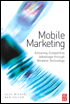
Technologies such as Wireless Application Protocol (WAP) and i-mode are enabling companies to design miniature Internet sites, specially created for mobile phones with smaller displays and thin connections. The mobile Internet or wireless Internet is still in its infancy, and its impact could be far greater than that of the PC-based version.
Advertiser-supported wireless sites use one of several business models in this emerging medium. Currently, there are three major types of advertiser-supported sites:
Sponsored content sites
Sponsored search agents and directories
Entry portal sites like Vodafone Live! (these sites in most instance are owned by the network operator).
At present, these three classes of sites are split at about 20 per cent, 20 per cent and 60 per cent, respectively, in terms of advertising revenue.
Advertising is expected to be an increasingly significant source of revenues in this new medium. Sponsored content is attractive because it is well suited to the wireless environment, yet retains important parallels to existing media in the physical world. Many wireless managers are beginning to place more importance on advertising revenue streams as a source of profitability for online content.
Against this backdrop, firms are trying to understand what makes wireless advertising successful. As advertisers and marketers debate the best ways to measure and track visits and usage on commercial wireless sites, most firms remain largely in the dark about how many customers exist online for their offerings. Because the industry currently lacks standards regarding what to measure and how...