Cartesian Coordinates
In Cartesian coordinates, Laplace's equation ? 2 S( x,y,z) = 0 is written as
| (2.1) | 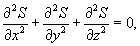
|
where - ? < x < ?, - ? < y < ?, - ? < z < ?. Applying separation of variables we assume a product solution
| (2.2) | 
|
Substituting this form of S into Laplace's equation and dividing by S gives
| (2.3) | 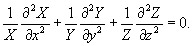
|
Each term in the above equation must be equal to a constant if the sum is zero for all x, y, and z, since these variables may vary independently
| (2.4) | 
|
where ? 2 + ? 2 = ? 2. The solutions to these differential equations may be written as linear combinations of sine, cosine, and exponential functions so that we may construct a product solution
| (2.5) | 
|
with constants determined by the boundary conditions.
As an example of the application of separation of variables, consider a unit square region with boundary condition S = 0 on three sides and S = 1 on the other side. Since there is no z dependence ? 2 = - ? 2 equation (2.5) become
| (2.6) | 
|
Applying the boundary conditions S(0, y) = S(1, y) = 0, where the sine function is zero given ? = n ? and relabeling the constants and writing the solution as a sum
| (2.7) | 
|
The condition S


 TABLE OF CONTENTS