Applied Electromagnetics Using Quickfield & MATLAB

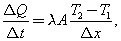
Thermal conduction acts to equalize temperature differences between regions of higher and lower temperatures. The rate of thermal energy Q transferred between two reservoirs at temperatures T 1 and T 2 separated by an insulator of thickness ? x is given by
| (11.1) | |
where A is the cross-sectional area and ? is the thermal conductivity of the insulating barrier. The rate ?Q/ ?t is positive in the lower temperature reservoir and vice versa as energy is transferred from the high temperature to the low temperature reservoir. Equation (11.1) may be written as a partial differential equation describing local heat flow in a material body with a one-dimensional temperature gradient
| (11.2) | |
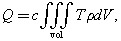
We seek to write equation (11.2) as a partial differential equation over a single scalar field T( x,t). The thermal energy stored in a body of volume V with constant temperature is given by Q = mcT, or with variable temperature and mass density
| (11.3) | |
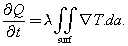
where c is the specific heat in J/kg K, T is the absolute temperature in Kelvins, and ? is the mass density in kg/m 3. The power loss due to the dissipation of thermal energy through a surface bounding the volume V is given by
| (11.4) | |
Setting the time derivate of equation (11.3) equal to equation (11.4) and applying Gauss' divergence theorem gives
| (11.5) | |
Note that equation (11.5) holds over arbitrary volumes so...