Applied Electromagnetics Using Quickfield & MATLAB
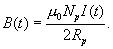
Faraday's law is the underlying principle describing eddy current induction and the operation of metal detectors. Metal detectors typically feature an outer drive coil that is energized at a given operating frequency with an inner pickup, or detection coil. The Biot-Savart law gives the unperturbed magnetic field at the center of the excitation coil
| (6.105) | |
If the secondary pickup loop is sufficiently small, the primary field will be nearly uniform over its area so that the total flux threading the pickup loop is ? m = ?R s 2 B( t) corresponding to an emf of E = -N s ? ? / ?t = -i ?? 0 ?R s 2 N sN pI( t) /2 R p in the absence of nearby metallic objects. If an object with a high permeability is brought near the pickup coil, the increased flux density will result in a greater induced voltage in the coil. A highly conducting object with low permeability will generate eddy currents that oppose the field produced by the drive coil resulting in an emf decrease in the secondary coil. Differential coil winding may be used to null the response due to the primary coil so that pickup signals result only from nearby metallic objects. Hybrid designs may also be employed, where a magnetometer is used instead of a secondary coil. Various magnetic sensors available include Hall effect sensors, fluxgate, and Superconducting Quantum...