Applied Electromagnetics Using Quickfield & MATLAB

QuickField enables the solution of time-harmonic magnetic problems with planar or axial symmetry. The permeability is anisotropic if x ? y in x-y symmetry or r ? z in axial symmetry. In x-y symmetry the vector potential is calculated according to
| (6.86) | |
and in axial symmetry
| (6.87) | |
The magnetic field components are calculated from the curl of the vector potential, as in the previous chapter. The electric field only has a ? component given by E ? = -i ?A ? in axial symmetry or a z-component in x-y symmetry E z = -i ?A z. The eddy current density is proportional to the vector potential J ? = - i ??A ? in axial symmetry and J z = -i ??A z in x-y symmetry.
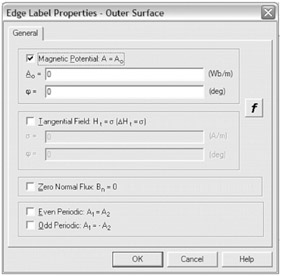
Boundary conditions are assigned in AC Magnetics in the same way as they are assigned in DC Magnetics except that they are understood to vary harmonically in time. The window for editing edge label data is shown in Figure 6.5. Vector potential and tangential field boundary conditions may be assigned spatial dependencies. The zero normal field condition, even and odd periodic boundary conditions may also be assigned in this window.