6.3 VECTOR POTENTIAL FORMULATION
In Chapter 5 we expressed the magnetic field as the curl of a vector potential B = ? A. Taking the time derivative of this expression
| (6.23) | 
|
and from Faraday's law ? E = - ? B/ ? t we have
| (6.24) | 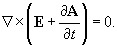
|
The quantity in brackets may be written as the gradient of a scalar potential
| (6.25) | 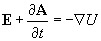
|
since the curl of the gradient is zero. If the electric potential is taken to be constant, as in a conductor, then
| (6.26) | 
|
For time-harmonic fields E = -i ? A, so that Maxwell's equation (6.10) becomes
| (6.27) | 
|
taking the Coulomb gauge, where ? A = 0 we obtain the vector Helmholtz equation
| (6.28) | 
|
with an additional term - ? 0 J source in the presence of sources. Once the vector potential is solved for in a conducting region, the eddy current density can be immediately obtained
| (6.29) | 
|
Analytical solutions to eddy current induction problems are often quite complex involving infinite integrals or summations over Bessel, or other special functions. However, the procedure for calculating eddy current distributions is quite similar for different conducting geometries. Analytical results are useful for the verification of computational methods and can often be extended to model more complex eddy current distributions using superposition integrals and summations as we demonstrate in the following sections.
Circular Coil Above a Conducting Half-Space
Dodd, Deeds, and Liquire treated eddy current induction problems in...

 TABLE OF CONTENTS