Applied Electromagnetics Using Quickfield & MATLAB

The continuity equation equates the divergence of the current density to the time variation of volume charge density ? J + ??/ ?t = 0. For fields that vary harmonically as exp( i ?t), the continuity equation can be written
| (10.1) | |
Substituting Ohm's law J = ? E and ? ? E = ? into equation (10.1) gives
| (10.2) | |
where E = - ? U so that
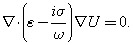
| (10.3) | |
This equation may be used to solve for the AC electric potential, field, and current flow in regions with varying dielectric permittivity and conductivity.
AC conduction analysis is performed in QuickField solving equation (10.3) that may be written in x-y symmetry as
| (10.4) | |
where ( ? x, ? y) and ( ? x, ? y) are the permittivity and conductivity components in the x- and y-directions, respectively. In axial symmetry we have that
| (10.5) | |
where ( ? r, ? z) and ( ? r, ? z) are the permittivity and conductivity components in the r- and z-directions, respectively.
Once the potential is solved for, the electric field is calculated from E = - ? U as in Electrostatics. The active and reactive current density components may then be obtained from J active = ? E and J reactive =