Applied Electromagnetics Using Quickfield & MATLAB

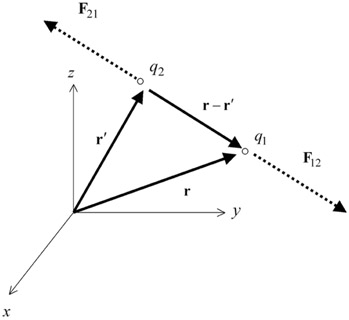
The force between two point charges separated by a distance r is proportional to the product of the charges and inversely proportional to the square of their separation. The force on charge q 1 due to q 2 in Figure 4.1 is given by
| (4.1) | |
where
is a unit vector that points from q 1 toward q 2. The force is attractive or repulsive depending on whether the charges have opposite or like signs, respectively. The force on q 1 is equal in magnitude and opposite in direction to the force on q 2 so that F 12 = - F 21 according to Newton's third law. The unit vector
may be written as
| (4.2) | |
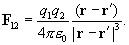
where q 1 is located at r and q 2 is located at r' so that F 12 is
| (4.3) | |
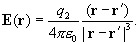
The electric field contribution at r due to charge q 2 at r' is given by F 12/ q 1 or
| (4.4) | |
On the CD Color images for many of the figures may be found on the CD-ROM.
In general, we can write that the force acting on a point charge q in an electric field E is given by F = q E. For a collection of point charges