Bayesian Logical Data Analysis for the Physical Sciences

The goal of this chapter is to provide an extension of logic to handle situations where we have incomplete information so we may arrive at the relative probabilities of competing propositions (theories, hypotheses, or models) for a given state of information. We start by reviewing the algebra of logical propositions and explore the structure (syllogisms) of deductive and plausible inference. We then set off on a course to come up with a quantitative theory of plausible inference (probability theory as extended logic) based on the three desirable goals called desiderata. This amounts to finding an adequate set of mathematical operations for plausible inference that satisfies the desiderata. The two operations required turn out to be the product rule and sum rule of probability theory. The process of arriving at these operations uncovers a precise operational definition of plausibility, which is determined by the data. The material presented in this chapter is an abridged version of the treatment given by E. T. Jaynes in his book, Probability Theory - The Logic of Science (Jaynes, 2003), with permission from Cambridge University Press.
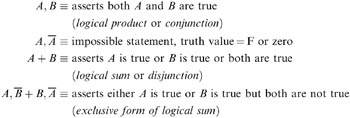
In general, we will represent propositions by capital letters { A, B, C, etc.}. A proposition asserts that something is true.
The denial of a proposition is indicated by a bar:
We will only be concerned with two-valued logic; thus, any proposition has a truth value of either