Bayesian Logical Data Analysis for the Physical Sciences

10.6: Correlated data errors

10.6 Correlated data errors

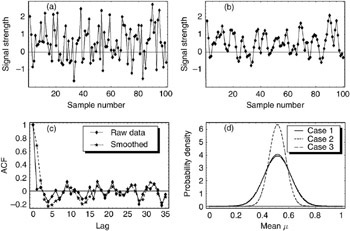
In this section, we compute the mean of a data set for which the off-diagonal elements of the data covariance matrix, E, are not all zero, i.e., the noise components are correlated. These correlations can be introduced by the experimental apparatus prior to the digitization of the data, or by subsequent software operations. Panel (a) of Figure 10.7 shows 100 simulated data samples of a mean, = 0 .5, with added IID Gaussian noise ( ? = 1). Panel (b) shows the same data after a smoothing operation that replaces each original sample ( d i) by a weighted average ( z i) of the original sample and its nearest neighbors according to Equation (10.119).

(10.119)

Figure 10.7: Panel (a) shows 100 independent samples of a mean value . In panel (b), the data have been smoothed using a running average that introduces correlations. Panel (c) compares the autocorrelation functions (ACF) for the raw data and smoothed data. Panel (d) compares the posterior density for for three cases. Case 1 is based on an analysis of the independent samples. The smoothed data results correspond to case 2 (assuming no correlations) and case 3 (including correlations).

If the characteristic width of the signal component in the data is very broad [13] (in this example the signal is a DC offset), then the smoothing will have little effect on the signal component. However, it will introduce correlations...

UNLIMITED FREE
ACCESS
TO THE WORLD'S BEST IDEAS

SUBMIT
Already a GlobalSpec user? Log in.

This is embarrasing...

An error occurred while processing the form. Please try again in a few minutes.

Customize Your GlobalSpec Experience

Category: Vibration and Acceleration Signal Conditioners
Finish!
Privacy Policy

This is embarrasing...

An error occurred while processing the form. Please try again in a few minutes.