Bayesian Logical Data Analysis for the Physical Sciences

Our task is to infer the parameters of some model function, f, that we sample in the presence of noise. We assume that we have N data values, d i, that are related to N values of the function f i, according to
| (10.1) | |
where e i represents an unknown error component in the measurement of f i.We assume that our knowledge (or lack thereof !) of the source of the errors is described by a Gaussian distribution for the e i. [3] For now, we assume the distribution for each e i to be independent of the values of the other errors, and that all of the error distributions have a common standard deviation, ?. We will later generalize the results to remove the restriction of equal and independent data errors.
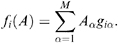
By a linear model, we mean that f i can be written as a linear superposition of M functions, g i?, where g i? is the value of the ?th known function for the ith datum. The M functions are each completely specified (they have no parameters); it is their relative amplitudes that are unknown and to be inferred. Denoting the coefficients of the known functions by A ?, we thus have
| (10.2) | |
Our task is to infer { A ?}, which we will sometimes denote collectively with an unadorned A, as we have...