D.1 Derivation of p(sN on, I)
In Section 14.4, we explored a Bayesian analysis of ON/OFF measurements, where ON is signal + background and OFF is a just the background. The background is only known imprecisely from OFF measurement. In this appendix, we derive Equation (14.17) for p( s N on, I), the posterior probability of the signal event rate.
Our starting point is Equation (14.16), which we repeat here together with some of the other relevant equations:
| (D.1) | 
|
| (D.2) | 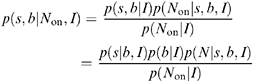
|
| (D.3) | 
|
| (D.4) | 
|
The denominator of p( s, b N on, I) in Equation (D.2) is given by
| (D.5) | 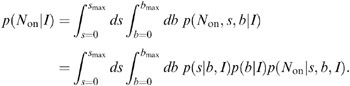
|
Substituting Equations (D.5), (D.4), (D.3) and (D.2) into Equation (D.1), we obtain
| (D.6) | 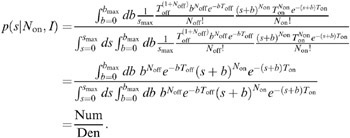
|
D.1.1 Evaluation of Num
We start with a binomial expansion of ( s + b) N on.
| (D.7) | 
|
The numerator of Equation (D.6) becomes
| (D.8) | 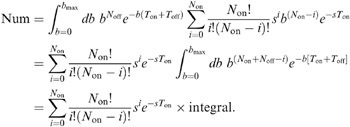
|
We now want to evaluate the integral in Equation (D.8), which we first rewrite in the form of an incomplete gamma function:
| (D.9) | 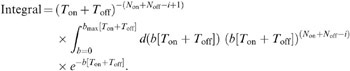
|
Compare this to one form of the incomplete gamma function:
| (D.10) | 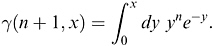
|
Thus, Equation (D.9) can be rewritten as
| (D.11) | 
|
Provided b max[ T on + T off] ? [ N on + N off ? i], we have that
| (D.12) | 
|
Substituting Equation (D.12) into Equation (D.11), we obtain
| (D.13) | 
|
Now substitute Equation (D.13) into Equation (D.8) to obtain
| (D.14) | 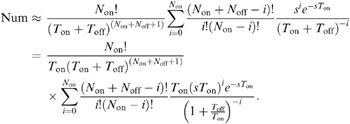
|
D.1.2 Evaluation of Den
The equation for denominator (Den) in Equation (D.6) is...


 TABLE OF CONTENTS