Bayesian Logical Data Analysis for the Physical Sciences

Chapter 14: Bayesian Inference with Poisson Sampling

Overview 14.1

In many experiments, the basic data consist of a set of discrete events distributed in space, time, energy, angle or some other coordinate. They include macroscopic events like a traffic accident or the location of a star. They also include microscopic events such as the detection of individual particles or photons in time or position. In experiments of this kind, our prior information often leads us to model the probability of the data (likelihood function) with a Poisson distribution. See Section 4.7 for a derivation of the Poisson distribution, and Section 5.7.2 for the relationship between the binomial and Poisson distributions.

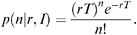
For temporally distributed events, the Poisson distribution is given by

(14.1)

It relates the probability that n discrete events will occur in some time interval T to a positive real-valued Poisson process event rate r. When n and rT are large, the Poisson distribution can be accurately approximated by a Gaussian distribution. Here, we will be concerned with situations where the Gaussian approximation is not good enough and we must work directly with the Poisson distribution.

In this chapter, we employ Bayes theorem to solve the following inverse problem: compute the posterior PDF for r given the data D and prior information I. We divide this into three common problems:

  1. How to infer a Poisson rate r.

  2. How to infer a signal in a known background.

  3. Analysis of ON/OFF data, where ON is the signal + background and...

UNLIMITED FREE
ACCESS
TO THE WORLD'S BEST IDEAS

SUBMIT
Already a GlobalSpec user? Log in.

This is embarrasing...

An error occurred while processing the form. Please try again in a few minutes.

Customize Your GlobalSpec Experience

Category: RF and Microwave Laminates
Finish!
Privacy Policy

This is embarrasing...

An error occurred while processing the form. Please try again in a few minutes.