In this appendix, we will derive the multivariate Gaussian distribution of Equation (8.59) from the MaxEnt principle, given constraint information on the variances and covariances of the multiple variables. We will start with the simpler case of only two variables, y 1 and y 2 , and then generalize the result to an arbitrary number of variables. We assume that the priors for y 1 and y 2 have the following form:
| (E.1) | 
|
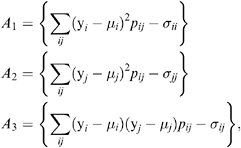
The constraints in this case are:
-

-

-

-

Because m( y i) is a constant, we solve for p( y 1, y 2 ) which maximizes
| (E.2) | 
|
where N = 2 in this case. The problem then is to maximize p({ y i}) subject to the constraints 1 to 4. This optimization is best done as the limiting case of a discrete problem. Let y i and y j (Roman typeface) represent the discrete versions of y 1 and y 2, respectively. Explicitly, we need to find the solution to
| (E.3) | 
|
where
and
This leads to
| (E.4) | 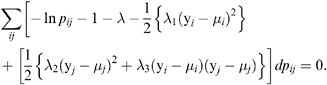
|
For each ij, we require
| (E.5) | 
|
or,
| (E.6) | 
|
where ? 0 = 1 + ?.
This generalizes to the continuum assignment
| (E.7) | 
|
To simplify the notation, we will use the abbreviation ?y 1 = ( y 1 ? 1 ) and ?y 2 = ( y 2 ? 2). Then Equation (E.7) becomes
| (E.8) | 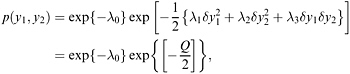
|
where
Copyright Cambridge University Press 2005 under license agreement with Books24x7


 TABLE OF CONTENTS