Bayesian Logical Data Analysis for the Physical Sciences

In Section 9.4, we explored a Bayesian treatment of the analysis of two independent measurements of the same physical quantity, the control and the trial, taken under slightly different experimental conditions. In the next four subsections, we give the details behind the calculations of the probabilities of the four fundamental hypotheses ( C, S), ( C, S), ( C, S) and ( C, S) which arose in Section 9.4.
After determining what is different, the next problem is to estimate the magnitude of the changes. Section 9.4.4 introduced the calculation for the probability of the difference in the two means p( ? D 1, D 2, I). The details of this calculation are given in Section C.3.
Finally, Section 9.4.5 introduced the calculation for the probability for the ratio of the standard deviations, p( r D 1, D 2, I). The details of this calculation are given in Section C.4.
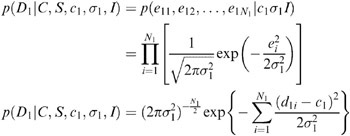
The only quantities that remain to be assigned are the two likelihood functions. The prior probability for the noise will be taken to be Gaussian.
where D 1 i = c 1 + e 1 i; therefore,
| (C.1) | |
| (C.2) | |
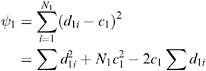
Let
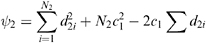
and
and
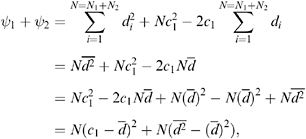
| (C.3) | |
where d and d 2 are the mean and mean square of the...