Bayesian Logical Data Analysis for the Physical Sciences

10.5: Model parameter errors

10.5 Model parameter errors

In Sections 10.2.1 and 10.2.2, we found the most probable values of linear model parameters. To complete the discussion, we need to specify the uncertainties of these parameters and introduce the parameter covariance matrix.

10.5.1 Marginalization and the covariance matrix

Now suppose that we are only interested in a subset of the model amplitudes (for example, one amplitude may describe an uninteresting mean background level, or, we may be interested in the probability density function of only one of the parameters). We can summarize the implications of the data for the interesting amplitudes by calculating the marginal distribution for those amplitudes, integrating the uninteresting nuisance parameters out of the full joint posterior. In this subsection we start by showing how to integrate out a single amplitude; the procedure can be repeated to remove more parameters. We then consider the special case of a model with only two parameters ( M = 2) and see how this leads to an understanding of the parameter errors.

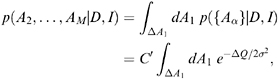
Suppose that the amplitude we want to marginalize out is A 1. Returning to the Q notation and IID Gaussian errors, the marginal distribution for the remaining amplitudes is then

(10.81)

where

(10.82)

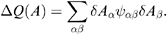
To perform the required integral, we first pull out the ?A 1 -dependent terms in ? Q, writing

(10.83)

where ?A 1 appears only in the first two terms.

Now we complete the square for ?A 1

UNLIMITED FREE
ACCESS
TO THE WORLD'S BEST IDEAS

SUBMIT
Already a GlobalSpec user? Log in.

This is embarrasing...

An error occurred while processing the form. Please try again in a few minutes.

Customize Your GlobalSpec Experience

Category: IC Electronic Filters
Finish!
Privacy Policy

This is embarrasing...

An error occurred while processing the form. Please try again in a few minutes.