Electromagnetics for High-Speed Analog and Digital Communication Circuits

Chapter 2: Capacitance

2.1 Electrostatics Review

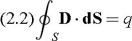
Let s begin with the all important Gauss Theorem. It is easy to show that the electric flux crossing any sphere surrounding a point source is constant and equal to the charge enclosed


This result is due to the 1/ r 2 dependence of the electric field. Gauss Law proves that for any surface (not just a sphere), the result is identical


Furthermore by superposition, the result applies to any distribution of charge


First of all, does it makes sense? For instance, if we consider a region with no net charge, then the flux density crossing the surface is zero. This means that the flux lines entering the surface equal the flux lines leaving the surface. Since charge is the source/sink of electric fields, this does make intuitive sense. We can prove that the flux crossing an infinitesimal surface of any shape is the same as the flux crossing a radial cone. Notice that if the surface dS is tilted relative to the radial surface by an angle ?, its cross-sectional area is larger by a factor of 1/cos ?. The flux is therefore a constant


For any problem with symmetry, it is easy to calculate the fields directly using Gauss Law. Take a long (infinite) charged wire as shown in Fig. 2.1. If the charge density is constant with density given by ?C/m, then by symmetry the field is radial. Applying Gauss Law to a small concentric cylinder surrounding the wire

UNLIMITED FREE
ACCESS
TO THE WORLD'S BEST IDEAS

SUBMIT
Already a GlobalSpec user? Log in.

This is embarrasing...

An error occurred while processing the form. Please try again in a few minutes.

Customize Your GlobalSpec Experience

Category: Magnetometers
Finish!
Privacy Policy

This is embarrasing...

An error occurred while processing the form. Please try again in a few minutes.