Electromagnetics for High-Speed Analog and Digital Communication Circuits

9.4: Transmission Line Termination

9.4 Transmission Line Termination

Up to now we have only considered an infinitely long uniform transmission in the z-direction. We found that such a structure supports voltages and currents which we have labeled as forward waves and backward waves (Eqs. 9.27 and 9.28)


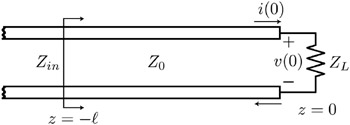
We would now like to focus on a terminated transmission line as shown in Fig. 9.9. In the figure we show a coaxial line terminated in a load impedance Z L at z = 0. Therefore, at the load, the following relation must hold


Figure 9.9: A transmission line terminated in a load impedance Z L.

or substituting z = 0 into the above equations


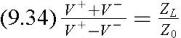
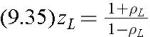
Henceforth we shall denote normalized impedances such as z L = Z L/ Z 0 with lowercase letters. Since there are two free variables V + and V ? and the constraint imposed by the load (Eq. 9.33), these parameters are now related. The variable ? L = V ?/ V + parameterizes this relationship. For obvious reasons, we call ? L the load reflection coefficient since it represents the fraction of the wave reflected from the load relative to the forward wave. Thus rewriting the previous equation in our new notation, we have


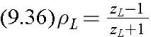
The above equation is easily inverted


We see that when a transmission line is terminated, the voltage and current on the line take on more specific forms due to the constraint of Eq. 9.33, which results...

UNLIMITED FREE
ACCESS
TO THE WORLD'S BEST IDEAS

SUBMIT
Already a GlobalSpec user? Log in.

This is embarrasing...

An error occurred while processing the form. Please try again in a few minutes.

Customize Your GlobalSpec Experience

Category: RF Couplers
Finish!
Privacy Policy

This is embarrasing...

An error occurred while processing the form. Please try again in a few minutes.