Electromagnetics for High-Speed Analog and Digital Communication Circuits

This chapter brings together many of the concepts from this book in order to analyze distributed circuits. In particular, we will analyze common integrated passive elements such as capacitors and resistors as distributed structures. We will also see how even a tiny transistor can act like a distributed circuit at high frequency. Next we consider transmission line transformers, structures that incorporate transformers in a distributed fashion for enhanced bandwidth. Finally, we ll outline the design of distributed structures incorporating active elements, such as distributed amplifiers.
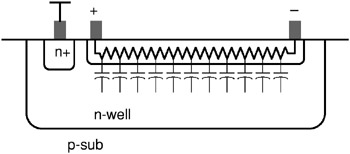
The analysis technique for lossy transmission lines can be applied to many practical problems. In Fig. 11.1, an IC resistor using a diffusion layer or thin film material is seen to couple to the substrate in a distributed fashion. A lumped model employing finite Cs and Rs can only work up to a certain frequency point.
Likewise, an IC capacitor Q factor is determined largely by the series resistance. Since the current through the plates is non-uniform in the direction along the plates, the resistance is not simply the total resistance of the plates due to the distributed effects.
The distributed resistor can be analyzed as a transmission line formed between the diffusion layer and the substrate. The capacitance per unit length is determined by the reverse-biased pn junction. At any frequency of interest, we assume that the resistance...