Electromagnetics for High-Speed Analog and Digital Communication Circuits

Chapter 4: Amp re, Faraday, and Maxwell

4.1 Am re: Static Magnetic Fields

Experimental observations

Consider a pair of parallel wires carrying steady currents I 1 and I 2. Since steady currents imply zero net charge distribution, there should be no electrostatic force between these current-carrying wires. But experimentally we do observe a force which tends to be attractive if the currents are in the same direction and repulsive if the currents are in the opposite direction. This new force is in fact an electrostatic force if we consider the problem from a relativistic point of view! Even though the net charge on each current-carrying conductor is zero in a static reference frame, in a moving reference frame there is net charge density and hence a force exists.

Magnetic force

Through careful observations, Amp re demonstrated that this force can be computed using the following equation


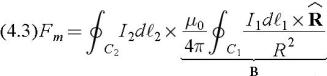
The resemblance to the Coulomb force equation is notable. Both forces fall like 1/ R 2. For steady currents, ? J = 0 implies that the currents must flow in loops. Thus we can calculate the force between two loops as follows


Magnetic field

Just as in the case of electric forces, the concept of action at a distance is disturbing and counterintuitive. Thus we prefer to think of the current in loop C 1 generating a field and then we say that this field interacts with the current in loop C 2 to generate a force. Simply reordering the magnetic force equation gives


where we...

UNLIMITED FREE
ACCESS
TO THE WORLD'S BEST IDEAS

SUBMIT
Already a GlobalSpec user? Log in.

This is embarrasing...

An error occurred while processing the form. Please try again in a few minutes.

Customize Your GlobalSpec Experience

Category: Magnetic Locks
Finish!
Privacy Policy

This is embarrasing...

An error occurred while processing the form. Please try again in a few minutes.