Electromagnetics for High-Speed Analog and Digital Communication Circuits

We can analyze the two-wire transmission line shown in Fig. 9.1 using the concept of distributed circuits. We note that this two-wire line stores both magnetic and electrical energy everywhere along the line in a distributed fashion. In other words, we cannot say that in some region the magnetic energy storage dominates and thus the line behaves inductively, whereas in another region the electrical energy storage dominates and thus the line behaves capacitively. Thus we now use a purely distributive circuit perspective shown in Fig. 9.5, a distributed ladder network with series impedance
and shunt admittance
. The prime denotes that the element in question is distributed, in other words there is
impedance per unit length.
To approximately find
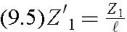
, we ignore the effects of the shunt admittance by focusing on the magnetic energy stored in the line. To do this, short the line at a distance ? from the input, as shown in Fig. 9.2a, and the line behaves like an inductor with impedance Z 1 accounting for its magnetic energy storage and loss. Since the line is uniform, we may define the impedance per unit length
Similarly, if we break the two-wire line at a distance ? and keep the end open, as shown in Fig. 9.2b, and only consider the...