Electromagnetics for High-Speed Analog and Digital Communication Circuits

We begin our study of transmission lines by first studying an infinite lumped ladder network shown in Fig. 9.4. It is interesting that we can find the input impedance of such a network (often a freshman physics problem). Simply observe that since the ladder network is infinite, addition of a single section to the front should not alter the impedance. With this observation we can show that
or
As shown in Fig. 9.3, suppose now that Z 1 = j ? L and Y 2 = j ? C. Then the input impedance of such a line is
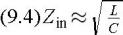
We would now like to make the leap from lumped to distributed. As such, we will assume that each inductor and capacitor in the ladder is very very small, in fact, infinitesimal in size. Therefore, for any finite frequency, the input impedance degenerates to
This is a very important and profound result. The input impedance is positive and real! Notice that we started out with strictly reactive elements and managed to construct a circuit with positive real input impedance. This final result is puzzling because the power dissipated by such a network is proportional to
( Z in). But since each section of the ladder is incapable of dissipating power, where does the energy go?
We will answer this...