Electromagnetics for High-Speed Analog and Digital Communication Circuits

Chapter 5: Inductance

5.1 Introduction

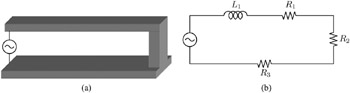
Inductance is an intrinsic part of every physical circuit in which currents flow. Even the simplest circuit shown in Fig. 5.1a cannot be fully understood unless the inductance is taken into account. Even though no inductor is drawn in the figure explicitly, there is a net electromagnetic force


Figure 5.1: (a) A simple circuit with inductance. (b) Schematic representation of circuit.

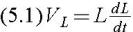
induced around the loop that tends to oppose any change in the current magnitude. The inductance L is a property of the loop related to the physical geometry of the circuit. We can represent this induced voltage by an element that has the voltage current relationship embodied in Eq. (5.1), as shown schematically in Fig. 5.1b. In this case, the inductance is a property of the loop and it does not stem from a separate coil (as suggested by the inductor s symbol) introduced into the circuit. While we can calculate the resistance of the loop by breaking the loop into three separate conductors, as suggested by R 1 ? R 3, this cannot be done easily with the inductance because the currents in the conductors interact magnetically.

But is this intrinsic inductance really important? Using techniques of this chapter we can determine the magnitude of L for a given circuit. From the application at hand, we can estimate dI/ dt or ? L in a steady-state periodic circuit and from Eq. (5.1) we can estimate the magnitude of the induced voltage. If

UNLIMITED FREE
ACCESS
TO THE WORLD'S BEST IDEAS

SUBMIT
Already a GlobalSpec user? Log in.

This is embarrasing...

An error occurred while processing the form. Please try again in a few minutes.

Customize Your GlobalSpec Experience

Category: Electrical Inductance Sensors
Finish!
Privacy Policy

This is embarrasing...

An error occurred while processing the form. Please try again in a few minutes.