Electromagnetics for High-Speed Analog and Digital Communication Circuits

The coaxial line shown in Fig. 9.6a is perhaps the most commonly encountered transmission line. In many residential areas, cable TV and Internet data services are delivered to homes via 75 ? transmission lines. Due to circular symmetry, the inductance and capacitance per unit length are readily calculated. An important observation comes from Eq. (9.32), which shows that the inductance and capacitance are in fact related. Thus, only one needs to be calculated and the other is easily inferred.
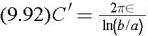
In Fig. 9.6a, the coaxial transmission line is shown with an inner conductor of radius a and outer conductor of radius b. We have already calculated the inductance and capacitance per unit length for such a line
since the propagation velocity of a TEM line is constant ![]()
Keep in mind that this is the external inductance per unit length. Only a perfect conductor will carry all of its current on the outer skin. In the limit of very high frequency, though, or when the radius of the conductor is much larger than the skin depth, a ? ?, the above formula applies. The conductance per unit length due to a lossy dielectric is easily derived since C ?/ G ? = ?/ ?. The series resistance per unit length, though, is more difficult to calculate.
To minimize the loss of a coaxial transmission line, we should minimize the conductive and resistive losses. The conductive losses can be...