Engineering Chemistry

Molecular spectroscopy is defined as the study of interaction of electromagnetic radiations with matter. It provides valuable information regarding molecular structure such as molecular symmetry, bond distances, bond angles; chemical structure such as chemical properties, electronic distribution, bond strength, molecular reactions; and thermodynamic properties.
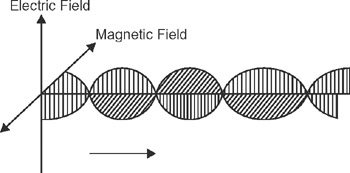
An electromagnetic radiation is a form of energy that is transmitted through space at an enormous velocity. Quantum mechanics suggests that electromagnetic radiation has a dual character, i.e., exhibiting wave as well as particle behavior. According to wave nature of radiations, the electromagnetic wave consists of oscillating electric and magnetic fields. The vectors of electric and magnetic fields are perpendicular to the direction of propagation of radiations (Figure 1.1).
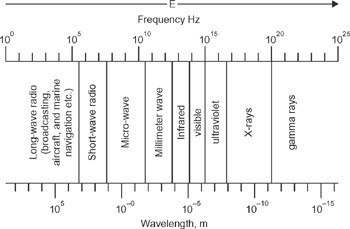
The electromagnetic spectrum extends from the radio wave to the microwave, infrared, visible, and ultraviolet regions. Beyond these are X-ray, gamma ray, and cosmic ray regions shown in Figure 1.2.
The wavelengths of visible light range from 400 nm (violet) to 800 nm (red). The visible region however, is a very small part of the entire electromagnetic spectrum. Wavelengths slightly shorter than those of the visible fall into ultraviolet region, while slightly longer wavelengths fall into infrared region. Some components of the electromagnetic spectrum are listed in Table 1.1 along with their wavelength, the energy associated with them, and the type of effect they are capable of producing...